
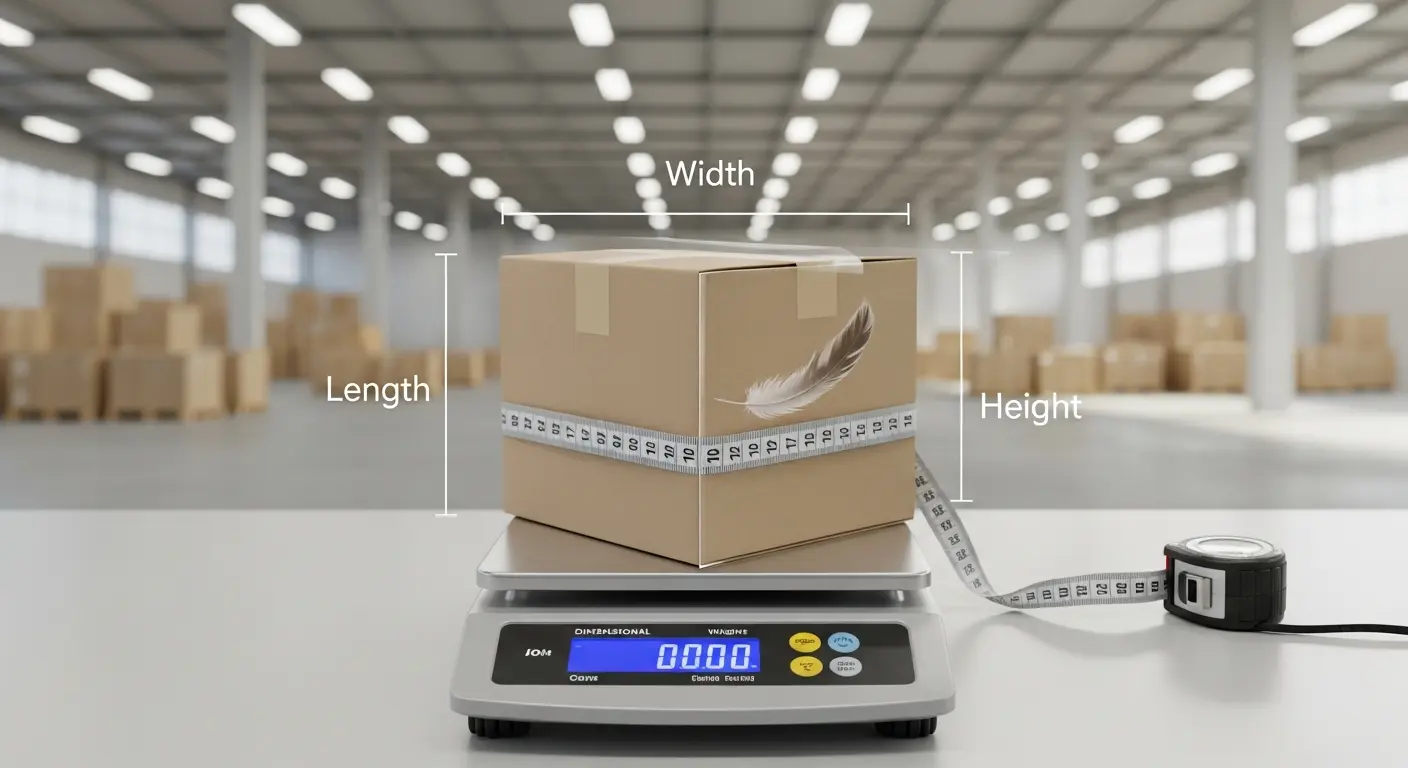
When you’re shipping bulky, lightweight products, choosing the wrong carrier can quietly drain your profit margins. The difference between carriers often comes down to one critical factor: their dimensional weight (DIM) pricing.
In this head-to-head comparison, we’ll break down exactly how UPS, FedEx, and USPS calculate dimensional weight in 2026, reveal which carrier actually saves you money on bulky items, and show you how to use this knowledge to optimize every shipment.
What Is Dimensional Weight and Why Does It Matter?
Before diving into carrier specifics, let’s quickly recap dimensional weight (also called volumetric weight).
Carriers don’t just charge based on how much a package weighs on a scale. They also consider how much space it occupies in their trucks and planes. A large, lightweight box takes up valuable cargo room that could hold multiple smaller, heavier packages.
Dimensional weight is calculated using this formula:
DIM Weight = (Length × Width × Height) ÷ DIM Factor
The DIM factor (or divisor) varies by carrier—and this variation is exactly where you can find significant savings.
Key Insight: A lower DIM factor means a higher calculated dimensional weight, which translates to higher shipping costs for the same box.

2026 DIM Factor Comparison: UPS vs. FedEx vs. USPS
Here’s how the three major U.S. carriers stack up:
| Carrier | DIM Factor | When It Applies | Maximum Package Size |
| UPS | 139 (daily/commercial rates) | All Ground packages | 150 lbs, 165″ L+G |
| UPS | 166 (retail rates) | Packages ≤1 cubic foot | 150 lbs, 165″ L+G |
| FedEx | 139 | All domestic & international | 150 lbs, 165″ L+G |
| USPS | 166 | Packages >1 cubic foot, Zones 5-9 only | 70 lbs, 108″ L+G* |
*USPS Ground Advantage allows up to 130 inches combined length and girth.
What Do These Numbers Actually Mean?
- FedEx uses a DIM factor of 139 across the board—no exceptions for domestic shipments
- UPS uses 139 for commercial/negotiated rates but offers 166for retail-rate packages under 1 cubic foot
- USPS uses the most favorable factor of 166, and only applies DIM weight to packages larger than 1 cubic foot shipping to Zones 5-9
This means USPS has a double advantage: a higher DIM factor and limited application of DIM pricing.
The Same Package, Three Different Prices
Let’s see how these DIM factors play out with a real example.
Package specs: – Dimensions: 16″ × 14″ × 12″ – Actual weight: 4 lbs – Destination: Zone 7 (cross-country)
Step 1: Calculate the Cubic Volume
16 × 14 × 12 = 2,688 cubic inches
This exceeds 1,728 cubic inches (1 cubic foot), so DIM pricing applies for all carriers.
Step 2: Calculate Dimensional Weight by Carrier
| Carrier | DIM Calculation | DIM Weight |
| FedEx | 2,688 ÷ 139 | 19.3 → 20 lbs |
| UPS (commercial) | 2,688 ÷ 139 | 19.3 → 20 lbs |
| USPS | 2,688 ÷ 166 | 16.2 → 17 lbs |
Step 3: Determine Billable Weight
Since the DIM weight exceeds the actual weight (4 lbs) for all carriers, each will bill based on dimensional weight:
- FedEx & UPS: Billed at 20 lbs
- USPS: Billed at 17 lbs
That’s a 15% lower billable weight with USPS—translating directly to lower shipping costs.
Want to run your own numbers? Use our Dimensional Weight Calculator to compare carriers instantly.
When USPS Is the Clear Winner
USPS offers the best value for bulky, lightweight shipments in these scenarios:
✅ Packages Over 1 Cubic Foot Going to Zones 5-9
This is where USPS truly shines. The combination of a 166 DIM factor versus FedEx/UPS’s 139 means you’ll consistently pay less for large, light boxes traveling across the country.
✅ Zones 1-4 Shipments (Any Size)
Here’s the often-overlooked advantage: USPS doesn’t apply dimensional weight pricing to Zones 1-4 at all. If your package ships within a regional footprint, you pay based on actual weight only—regardless of box size.
✅ Items Under 1 Cubic Foot
For packages measuring less than 1,728 cubic inches, USPS charges based on actual weight only. FedEx and UPS (at commercial rates) still apply their DIM factor of 139 to all packages.
✅ Flat Rate Options
USPS Flat Rate boxes bypass dimensional weight entirely. If your bulky item fits in a Flat Rate box, you pay a fixed price regardless of weight (up to 70 lbs) or destination zone.
When UPS and FedEx Make More Sense
Despite USPS’s DIM advantage, there are situations where UPS or FedEx is the better choice:
Heavy or Oversized Packages
- USPS max weight: 70 lbs
- UPS/FedEx max weight: 150 lbs
If your package exceeds 70 lbs or measures over 108 inches (combined length + girth), USPS isn’t an option.
Speed and Reliability Requirements
For guaranteed delivery windows, extensive tracking, and business-critical shipments, UPS and FedEx offer more robust service levels and accountability.
High-Volume Commercial Shipping
When you’re shipping thousands of packages monthly, negotiated rates with UPS or FedEx can sometimes beat USPS—especially with custom DIM factor agreements. Working with a 3PL fulfillment partner often unlocks these preferred rates.
International Shipments
For global shipping, FedEx and UPS typically offer better international networks, customs handling, and end-to-end tracking compared to USPS.
2026 Carrier Updates You Need to Know
Several important changes affect dimensional weight pricing in 2026:
UPS and FedEx Rounding Changes
As of August 2025, both UPS and FedEx round each dimension UP to the nearest whole inch before calculating DIM weight. This can increase your billable weight on packages with fractional measurements.
USPS Dimensional Reporting Expansion
Starting July 12, 2026, USPS is removing size thresholds for dimensional reporting. All commercial Priority Mail, Priority Mail Express, Ground Advantage, and Parcel Select packages will require accurate length, width, and height—regardless of size. Inaccurate dimensions will trigger Dimension Noncompliance Fees.
Rate Changes
USPS retail Priority Mail rates increased an average of 6.6%effective January 18, 2026. However, commercial rates through shipping platforms have remained competitive, with some Priority Mail Cubic tiers actually decreasing.
DIM Factor Strategy: Choosing the Right Carrier
Here’s a decision framework for selecting the optimal carrier based on your package profile:
For Bulky, Lightweight Items (Under 70 lbs)
| Scenario | Best Carrier | Why |
| Shipping to Zones 1-4 | USPS | No DIM weight applied |
| Shipping to Zones 5-9 | USPS | 166 DIM factor vs. 139 |
| Fits in Flat Rate box | USPS | No DIM calculations at all |
| Need guaranteed delivery | UPS/FedEx | Better service guarantees |
For Heavy or Oversized Items (Over 70 lbs)
| Scenario | Best Carrier | Why |
| 70-150 lbs | UPS or FedEx | USPS doesn’t accept |
| Over 108″ L+G | UPS or FedEx | Only option available |
For High-Volume Shippers
Consider working with a fulfillment center that has negotiated rates with multiple carriers. They can automatically select the optimal carrier for each package based on dimensions, weight, destination, and delivery requirements.
How to Reduce DIM Weight Charges Across All Carriers
Regardless of which carrier you use, these strategies minimize dimensional weight impact:
1. Right-Size Your Packaging
Use the smallest box possible that safely protects your product. Custom box sizes tailored to your bestsellers can dramatically reduce DIM weight charges.

Learn more about optimized packaging strategies.
2. Consider Alternative Packaging
- Poly mailers for soft goods eliminate rigid box dimensions entirely
- Padded envelopes for small, flat items
- Vacuum-sealed packaging for compressible products
3. Calculate Before You Commit
Never assume actual weight determines your cost. Use our Dimensional Weight Calculator to check every new product or box configuration.

4. Compare Carriers for Every Shipment
A package that’s expensive with FedEx might be significantly cheaper with USPS—or vice versa. Multi-carrier comparison should be standard practice, especially for ecommerce fulfillmentoperations.
The Bottom Line: USPS Wins for Bulky Items (With Caveats)
For lightweight, bulky packages under 70 lbs, USPS is typically the most cost-effective option in 2026, thanks to:
- Higher DIM factor (166 vs. 139) = lower calculated DIM weight
- Zone restrictions = no DIM pricing for Zones 1-4
- Flat Rate options = bypass DIM calculations entirely
However, UPS and FedEx remain essential for heavy packages, guaranteed delivery, and high-volume commercial shipping with negotiated rates.
The smartest approach? Compare carriers on a per-package basis using actual dimensions and weights—then route each shipment to the most cost-effective option.
Compare Your Packages Now
Ready to see exactly how carrier choice affects your shipping costs? Our free Dimensional Weight Calculator lets you plug in your box dimensions and instantly compare what you’d be billed across carriers.
Need help optimizing your shipping strategy? Contact ShipCorefor a free consultation. Our fulfillment experts help ecommerce brands reduce shipping costs by automatically selecting the optimal carrier for every package.
Frequently Asked Questions
Which carrier has the best DIM factor in 2026?
USPS offers the most favorable DIM factor of 166, compared to 139for FedEx and UPS commercial rates. This makes USPS typically cheaper for bulky, lightweight items.
Does USPS apply dimensional weight to all packages?
No. USPS only applies DIM weight to packages that exceed 1 cubic foot (1,728 cubic inches) and ship to Zones 5-9. Packages under 1 cubic foot or shipping to Zones 1-4 are billed based on actual weight only.
Can I negotiate DIM factors with carriers?
Yes. High-volume shippers can often negotiate custom DIM factors with UPS and FedEx. Alternatively, partnering with a 3PL providergives you access to their pre-negotiated rates without minimum volume requirements.
What’s the maximum package size for each carrier?
- USPS: 70 lbs, 108″ combined length + girth (Ground Advantage: 130″)
- UPS: 150 lbs, 165″ combined length + girth
- FedEx: 150 lbs, 165″ combined length + girth
How do I calculate dimensional weight?
Use the formula: (Length × Width × Height) ÷ DIM Factor. The DIM factor is 139 for FedEx/UPS commercial and 166 for USPS. Or skip the math and use our Dimensional Weight Calculator.
Shipping costs eating into your margins? Get a free shipping analysis from ShipCore’s fulfillment experts and discover how much you could save with optimized carrier selection.